About This Course
A 9-chapter, self-paced course that walks you through every phase of the accreditation process.
It starts from the "Accreditation 101" basics and works through building a sustainable accreditation program in your agency and increasing public trust.
The course Includes interactive elements, checkpoints, and capstone scenarios in each major chapter, so you can apply what you're learning to realistic scenarios.
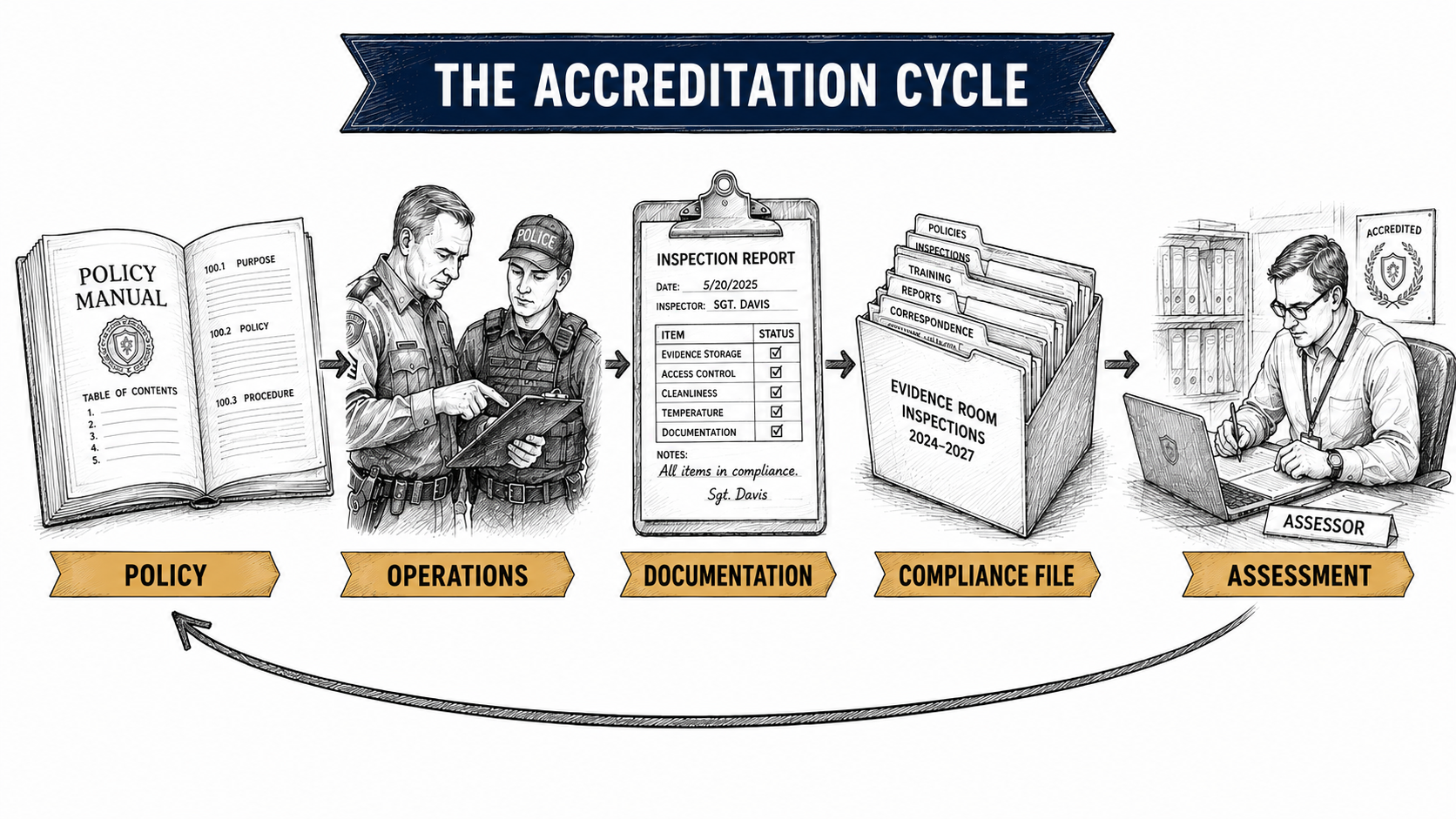
What Makes This Course Different
Most accreditation guidance is scattered across binders, standards manuals, and hallway conversations with whoever did it last time.
This course puts the entire process in one place — using a realistic case-study agency (River Valley PD) so you see exactly how policies, proofs of compliance, and the site visit actually play out, not just what the standards say in the abstract.
What You'll Learn
-How to read and interpret accreditation standards theway assessors do
-Building and organizing proof-of-compliance files that hold up under review
-Running effective self-assessments and gap analyses
-Managing the assessment cycle and staying audit-ready year-round
-Preparing your agency and personnel for a site visit
-What actually happens during the on-site assessment — hour by hour
-How to handle findings, respond to concerns, and follow through after the visit
For Accreditation
Managers
Just handed accreditation responsibilities and need to get up to speed fast.
For Command
Staff
Overseeing accreditation for the first time and want to lead it with confidence.
For First-Time
Accreditation
Preparing for your initial assessment and want to know what to expect.
For Reaccreditation Teams
Working toward reaccreditation and looking to tighten up the process.
For Training
Coordinators
Inherited accreditation duties without a roadmap to follow.
For Self-Directed
Learners
Want a clear, step-by-step process instead of piecing it together from binders and hallway conversations.
Course Curriculum
- 2.1 What is a Standard?
- 2.2 Structure of a Standard
- 2.3 Not Applicable, Non-Compliant, and Optional Standards
- 2.4 Understanding Accreditation Language
- 2.5 What is the Standard Measuring?
- 2.6 Common Misunderstandings
- 2.7 Standards in Real Agency Operations
- 2.8 Checkpoint Reflection
- CHAPTER 2 CAPSTONE ACTIVITY
- 5.1 What is an Accreditation Assessment?
- 5.2 What are Assessors Looking For?
- 5.3 Assessment Cycles and Ongoing Compliance
- 5.4 Common Assessment Problems
- 5.5 The Operational Side of Assessments
- 5.6 Assessment Prep and Organization
- 5.7 Making Assessment Decisions
- 5.8 Checkpoint Reflection
- CHAPTER 5 CAPSTONE ACTIVITY
- 6.1 What does an Accreditation Program Look Like?
- 6.2 The Role of the Accreditation Manager
- 6.3 Building Organizational Workflows
- 6.4 Organizational Accountability and Communication
- 6.5 Continuous Compliance vs. Accreditation Panic
- 6.6 Accreditation as Organizational Culture
- 6.7 Checkpoint Reflection
- CHAPTER 6 CAPSTONE ACTIVITY
- 7.1 Accreditation Beyond Paperwork
- 7.2 Supervision and Accountability
- 7.3 Training and Operational Consistency
- 7.4 Documentation Culture and Operational Habits
- 7.5 Risk Management and Organizational Improvement
- 7.6 Leadership and Organizational Support
- 7.7 Accreditation as a Continuous Operational System
- 7.8 Checkpoint Reflection
- CHAPTER 7 CAPSTONE ACTIVITY
- 8.1 Why Programs Erode After Success
- 8.2 From Habits to Systems: Institutionalizing Compliance
- 8.3 Keeping Policies Alive: The Directive Lifecycle
- 8.4 Multi-Year Audit and Training Trends
- 8.5 Institutional Knowledge and Staff Turnover
- 8.6 From Reaccreditation to Reaccreditation
- 8.7 Checkpoint Reflection
- CHAPTER 8 CAPSTONE ACTIVITY
- 9.1 Accreditation and Professional Identity
- 9.2 Accountability and Organizational Consistency
- 9.3 Turning Findings Into Organizational Learning
- 9.4 Leadership Oversight and Organizational Visibility
- 9.5 Public Trust and Transparency
- 9.6 Accreditation as Organizational Culture
- 9.7 Final Reflection Checkpoint
- CHAPTER 9 CAPSTONE ACTIVITY

Meet Andretta Swift
Andretta is a Connecticut police officer turned law enforcement researcher and consultant who has played a direct role in the successful accreditation of dozens of police departments.
Her approach to teaching accreditation comes from an unusual vantage point: she worked with agencies facing a newly adopted state mandate for police accreditation. These were departments that had no intention of becoming accredited and were navigating accreditation without the knowledge, resources, and support needed to succeed.
That's the same approach this course takes with you.
Her academic work reinforces that hands-on experience. Andretta holds a Master of Legal Studies in Criminal Law and Policy from Arizona Law, giving her a deep grounding in the legal frameworks and policy reasoning behind accreditation standards. Her doctoral research focuses specifically on accreditation and organizational change — the "why" behind what makes some agencies sail through the process and others struggle, which is the throughline of every chapter in this course.
Between the fieldwork and the research, Andretta has seen accreditation succeed and fail from nearly every angle — as a practitioner in the room, and as a researcher studying why it works. This course is built to hand you that same vantage point.